
Transparency · 8-point check · Re-verified each season
Verified Rafting Operators in Rishikesh — The 8-Point Check We Run Before Anyone Takes Your Booking
Rishikesh has hundreds of rafting operators. Some run safety like their licence depends on it — because it does. Some don't. Every operator on RaftingX passes the same 8-point check before they can take a single booking from you — here's what we actually verify, and what you should ask any operator you're considering.
- 8-point verification
- Re-checked every season
- Failed operators removed
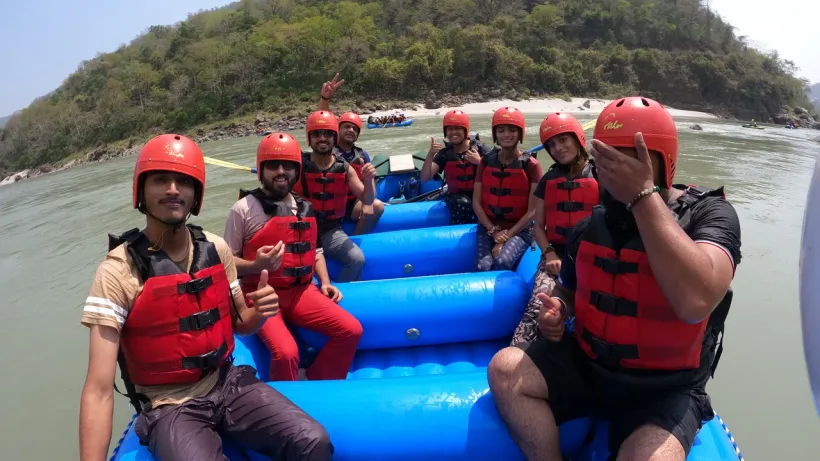
A verified rafting operator in Rishikesh is one whose Uttarakhand Tourism rafting permit, gear inventory, guide credentials, briefing protocol, safety-kayaker coverage, GPS infrastructure, incident reporting, and customer service have all been checked against platform-level standards. RaftingX runs that 8-point check on every operator before they list on the platform, then re-checks at the start of every season and at random points through it. Operators failing any check are removed from fair-rotation until the issue is fixed.
Why operator verification is the single highest predictor of trip safety
The parent safety pillar lays out the five factors that determine whether your rafting trip is actually safe: permit status, gear standards, guide certification, safety-kayaker presence, and GPS tracking. Notice what those five factors have in common — the operator controls all of them.
You can't change which life jacket is on the raft. You can't change which guide reads the rapid. You can't change whether a safety kayaker shadows the Grade IV section. You picked the operator; the operator picked the rest.
That makes verification — the upstream filter on which operators can even take a booking — the single highest-leverage point on the safety chain. The overwhelming majority of avoidable rafting incidents trace to operators who would not pass any verification framework. Verification isn't bureaucracy — it's the actual safety system.
The 8-point check RaftingX runs on every operator
A richer published version of this section — with the exact gear-age thresholds, kayaker-to-raft ratios per route, and guide-experience floors — will land on this page as soon as the operator-side verification process is finalised for the 2026-27 season. The platform-level checks below are what's in operation today.
1. Permit status — Uttarakhand Tourism rafting permit on file
Every legal Rishikesh rafting operator must hold a current permit issued by the Uttarakhand state tourism authority. The permit is annual and conditional on safety, gear, and guide standards. Unlicensed operators do exist — they undercut licensed prices, run trips during the monsoon closure, and operate from informal launch points. The platform verifies the permit document and number against the state directory at the start of every season, and removes any operator whose permit lapses mid-season. No current permit, no listing. This is the lowest bar; everything else builds on it.
2. Gear inventory — life-jacket age, helmet condition, paddle stock, raft hours
Two pieces of gear decide whether you survive a swim — the life jacket and the helmet. Life jackets must be certified for whitewater use and must fit snugly under the arms; an old jacket can ride up over a swimmer's face in fast water. Helmets must have an intact shell and a working chin strap. The platform tracks gear inventory per operator and inspects on-site at season open. Verified operators hold their gear to a tighter standard than the regulatory minimum.
A note on life jacket spec. Operators in India use a mix of certifications. The Indian Bureau of Standards (BIS) issues the ISI mark for water-sports buoyancy aids — the certification you'll find on gear from established Indian outfitters. Imported gear may carry international whitewater PFD standards: USCG Type III or V (US), CE / EN (Europe). All meet whitewater certification floors. Every verified operator on RaftingX provides life jackets carrying at least one of these certifications — never below. The platform verifies the certification documentation at each operator's annual gear audit.
3. Guide credentials — swift-water rescue training and on-river hours
Two things separate a competent guide from a beginner with a paddle: documented swift-water rescue training and time on this specific stretch of the river. The first means the guide can execute a recovery when a line goes wrong. The second means the guide knows where the hazards are on this water level today, not in general. The platform requires training documentation on file and on-river hours logged per guide per season. A guide can't be added to a verified operator's roster without that paperwork.
4. Briefing protocol — paddle commands, fall-out drill, rescue commands
The eight-to-twelve minute briefing before the raft pushes off is where most of the trip's safety is actually transmitted. A verified operator's briefing covers paddle commands, the swim position if you fall out (on your back, feet downstream, toes up), rescue commands, equipment-fitting verification, and any route-specific hazards for today's water level. The platform audits the briefing via mystery-shopper trips and customer surveys. A rushed briefing is the single most common pre-launch failure mode; it gets flagged.
5. Kayaker availability — a safety kayaker on every Grade IV trip
The safety kayaker is the actual rescue mechanism on Grade IV water. The kayaker rides alongside or just behind the raft through every Grade IV rapid; if a rafter falls in, the kayaker reaches them in seconds — faster than the raft can turn around. The platform requires a safety kayaker on every Grade IV trip — that means every Marine Drive trip and the Roller Coaster opener on Shivpuri; Brahmpuri is Grade II–III so kayaker is recommended, not mandatory.
6. GPS infrastructure — every raft trip on the platform is tracked
Every raft on every RaftingX trip carries a GPS tracker logged to the platform. The operator's base sees the raft in real time. Family contacts get a tracking link if they ask. In the event of an incident, the operator and the platform know the exact location — no guessing, no minutes lost to "where exactly are they." The tracker also auditably enforces fair-rotation — the platform can prove which operator ran which trip, when, on what route. GPS isn't optional on the platform — it's a baseline.
7. Incident reporting — logged within 24 hours, regardless of severity
An incident isn't only a hospital visit. A near-miss matters. A loose helmet caught only after launch matters. A gear failure mid-rapid matters. Verified operators log every incident — minor or major — to the platform within 24 hours, and the platform reviews patterns monthly. A single isolated incident on a Grade IV rapid is the system working; a pattern of unreported events is grounds for verification removal. An operator who hides incidents is more dangerous than one who logs them, because hidden incidents repeat.
8. Customer service — response time, refund policy, reschedule terms
Customer service isn't the safety variable a rafter usually thinks about — but it's the variable that decides whether you're informed before launch. Verified operators meet platform standards on booking-response time, confirm trip dates and meet-points in writing, deliver photos on the agreed schedule, and honour refund and reschedule terms when river conditions force a change. An operator that ducks the booking conversation will duck the incident conversation — so the platform tracks complaint-to-booking ratios per operator.
What an unverified operator looks like — 7 red flags
You can spot most unverified operators before you hand over money. The seven most common signals:
- "₹300 per person" advertised pricing. Real operating cost — certified whitewater life jacket (ISI-marked) replacement, fully-trained guide, safety kayaker, GPS tracker — cannot be covered at ₹300. Operators advertising that floor are skipping at least one of the four.
- No permit number on their website, WhatsApp profile, or printed material. The Uttarakhand Tourism rafting permit is mandatory and easy to display. Operators who don't display it usually don't hold one.
- Vague guide credentials. "Trained guides" with no specifics means none. A verified operator names the training — swift-water rescue, on-river years — without being asked twice.
- Cash-only payment. Modern operators take UPI and card. Cash-only means no audit trail, often no insurance. An accountability gap on the financial side usually mirrors one on safety.
- Operating during monsoon (July to mid-September). The river is closed by Uttarakhand state order. Any operator offering you a monsoon trip is breaking the law and operating outside any safety envelope.
- No briefing on the day. "We go straight to the river" is a serious red flag. A verified operator briefs the raft for eight to twelve minutes before pushing off.
- No GPS tracking offered. Verified operators track every trip. If the operator can't share a tracking link before launch, the operator can't tell anyone where you are if something goes wrong.
How RaftingX runs the verification — the operational process
The 8-point check isn't a one-time form fill. It's a five-stage cycle that runs every season:
- Pre-season audit (August–September). Document audit (permits, training certificates, insurance), on-site gear inspection at the operator's base, guide roster review. Anything that doesn't meet the standard either gets replaced before season open, or the operator doesn't list.
- Season-open spot checks (September 15–30). Mystery-shopper trips with each operator to verify the briefing protocol on the water and on-launch standards in practice.
- In-season monitoring (October–June). Rafter feedback after every trip, incident logs reviewed monthly, GPS data auditable per trip, customer-service response time tracked. The data layer catches drift faster than human observation could.
- Mid-season review (January). Operators below threshold get warnings and corrective action plans; operators below the floor get suspended from fair-rotation until they fix the issue.
- End-of-season review (July). Full performance audit; lessons applied to next season's process. Operators who fail any season's verification are removed from the platform.
What you can verify yourself — checks any rafter can run
Even if you're not booking through RaftingX, here's what you can verify on any operator you're considering. These checks take ten minutes total and catch most of the unverified-operator failure modes:
- Ask for the Uttarakhand Tourism rafting permit number. A verified operator will share it on WhatsApp without hesitation. An unverified one will deflect.
- Ask the age of the life jackets. Older than three years, ask why and ask to inspect the buoyancy. Older than five — decline.
- Ask for guide certification details. Training name, years on this stretch of the river. Specifics, not slogans.
- Ask about kayaker coverage for the route. Mandatory for Grade IV. If the answer is "depending on group size" or "sometimes," that's a no.
- Ask about GPS tracking. If the operator can't share a tracking link before launch, the operator can't tell anyone where you are mid-trip.
- Read recent Google reviews — last 30 days, not the lifetime average. Recent reviews surface current operational quality.
- Verify the payment method matches the business. The UPI ID should match the operator's registered business name; mismatches are accountability gaps.
Re-verification — what happens every season
Verification isn't a badge an operator earns once. All eight checks run again at the start of every season:
- Permit re-confirmation against the state directory — operators whose permit has lapsed mid-summer don't auto-renew.
- Gear re-inspection — anything aged out gets replaced or the operator loses approval for that route.
- Guide roster refresh — new guides verified before they take rafters; departures logged.
- Briefing audit refresh via mystery-shopper trips during the September 15–30 window.
When the platform publishes its first annual transparency report, it'll list operators that failed, were suspended, and were reinstated — with reasons. "Verified" is a continuous status, not a stale badge.
What happens when an operator fails verification
Four steps, applied based on severity:
- Warning plus corrective action plan if the failure is borderline — out-of-date gear that can be replaced in 30 days, a guide-roster gap that can be filled before next month's bookings.
- Suspension from fair-rotation if the failure is material — expired permit, gear past safe life with no replacement plan, a missing kayaker on Grade IV trips, a pattern of unreported incidents.
- Removal from the platform if the failure is structural — repeated suspensions, false documentation, refusal to fix a flagged issue.
- Public note on removal in the annual transparency report.
The willingness to remove operators is the credibility differentiator. Hiding removed operators makes the platform meaningless.
Frequently asked questions about operator verification
What is a "verified rafting operator"?
An operator whose Uttarakhand Tourism rafting permit, gear inventory, guide credentials, briefing protocol, safety-kayaker availability, GPS infrastructure, incident reporting, and customer service have all been checked against RaftingX's platform-level standards. Verification is renewed every season at the September 15 reopening, with random spot checks in between.
How is RaftingX verification different from just having a state permit?
A state permit is the minimum legal requirement to operate at all. RaftingX layers seven additional checks on top — gear age and condition, guide credentials, briefing protocol, kayaker coverage, GPS, incident reporting, customer service. Many permit-holding operators wouldn't pass the full RaftingX check today.
How do I know an operator on RaftingX has actually been verified?
Every operator listed on the platform has passed the 8-point check before they can take a booking. If you have a specific concern about a specific operator, contact RaftingX and the verification record for that operator can be shared with you for your booking.
How often does RaftingX re-verify operators?
Full re-verification at every season open (September 15). Spot checks during the September 15–30 window. Continuous in-season monitoring via incident logs, GPS data, and rafter feedback. Mid-season review in January. End-of-season audit in July.
Has RaftingX ever removed an operator from the platform?
The platform is in its launch season. Removal counts and reasons will publish in the first annual transparency report. As verification cycles continue, the public record will grow — the willingness to remove is what makes the verification framework credible in the first place.
What is the difference between "verified" and "licensed"?
Licensed means the operator holds a current Uttarakhand Tourism rafting permit — the legal floor. Verified means licensed plus the additional seven platform-level checks. Licensed = legal; verified = legal plus a quality threshold above the regulatory minimum.
Can I see which operators on RaftingX are verified for which routes?
Not all operators are approved for all routes — Grade IV approval is stricter than Grade II. When you book a route through the platform, only operators verified for that route are matched. You can ask before payment which operator you will be matched with.
How can I report an operator I think should not be verified?
WhatsApp the platform with the operator name, your concerns, and any documentation (photos of gear, a screenshot of an unsafe response, a refund dispute). Every report is investigated. Operators reported by multiple unrelated rafters get expedited review.
Book a verified operator
A verification framework only matters if you actually use it. Every operator on the platform has passed the 8-point check above before they could accept a booking. Re-checked at season open. Continuously monitored. Removed if they fall below the line.
Ready to book a verified Rishikesh rafting trip?
Related reading
- Rishikesh Rafting Safety — The Standards That Actually Matter — the parent pillar explaining the five factors that decide trip safety.
- Is Rishikesh Rafting Safe? A 2026 Reality Check — the sister post on the same wedge.
- What to Wear Rafting in Rishikesh — what gear belongs on you before you launch.
- Plan your trip — when to come, how to reach, where to stay.