Trust · Verified operators · GPS-tracked
Rishikesh Rafting Safety — The Standards That Actually Matter
The river is unforgiving. The operator infrastructure is fragmented. This is what determines whether your rafting trip is actually safe — and how RaftingX verifies every operator before they take a booking from you.
- 300+ verified operators
- Safety kayaker on every Grade IV rapid
- GPS-tracked trips
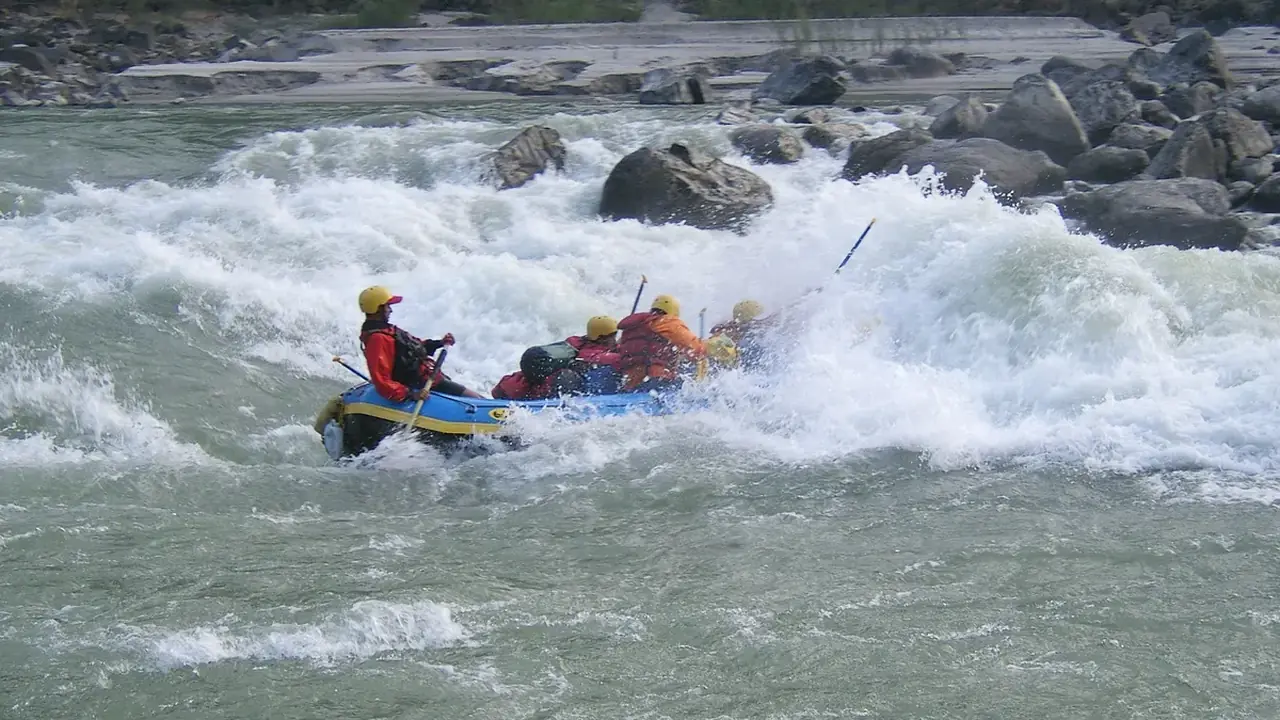
Rishikesh rafting, when booked with a verified operator, has an excellent safety record — comparable to other regulated whitewater destinations globally. The actual safety of your trip depends on five specific factors: the operator's Uttarakhand Tourism rafting permit, the gear standards in use, the guide's certification, the presence of a safety kayaker, and whether the trip is GPS-tracked. Three of these are visible from the outside before you book; two require operator-level verification. RaftingX exists to verify all five on your behalf.
How dangerous is Rishikesh rafting, really?
Commercial whitewater rafting is statistically safer than most people assume. Regulated Grade II to IV rafting — the range covered by the three Rishikesh commercial routes — has incident rates lower than skiing and comparable to scuba diving across published global industry data. Aggregated Uttarakhand-state incident data isn't publicly available, so RaftingX is committed to publishing its own quarterly incident report once running at scale.
Risk shifts meaningfully with rapid grade:
- Grade II (most of Brahmpuri): comparable to a moderate amusement-park ride. Real but bounded.
- Grade III (most of Shivpuri, parts of Marine Drive): real but manageable — requires fitted gear, a proper briefing, and a guide who reads the line right.
- Grade IV (3 named rapids on Marine Drive): meaningful. A flip is possible. The actual safety variable is recovery — how fast a swimmer reaches the safety kayaker, or the raft, or a stable position downstream.
The danger isn't the river. The danger is the gap between regulated and unregulated trips on the same river — and that gap is what RaftingX exists to close.
The 5 factors that actually determine safety
1. Is the operator licensed?
Every legal Rishikesh rafting operator must hold a current Uttarakhand Tourism rafting permit. The permit is conditional on safety, gear, and guide standards — though enforcement varies. Unlicensed operators exist anyway, usually offering eye-catchingly cheap trips that skip the parts of the operation a permit requires. The first thing any rafter should verify is the operator's permit status. Every operator on RaftingX holds a current permit — confirmed at the start of every season.
2. Is the gear certified, recent, and properly fitted?
Certified whitewater life jackets are mandatory on every verified-operator trip. The Indian Bureau of Standards (BIS) issues the ISI mark for water-sports buoyancy aids — that's the certification you'll find on gear from established Indian outfitters. Imported gear may carry international whitewater PFD standards: USCG Type III or V (US), CE / EN (Europe). All are acceptable provided certification documentation is on file with the operator. Beyond the certification itself, two things matter: age (life-jacket buoyancy degrades by 20–30% after three years of regular use) and fit (a loose jacket can ride up over a swimmer's face in fast water). The same logic applies to helmets — current certification, intact shell, snug chin strap. Cheap operators reuse old gear past its safe life. Verified operators on RaftingX hold their gear to a tighter standard than the regulatory minimum.
3. Is the guide certified and experienced?
Two things separate a competent rafting guide from a beginner with a paddle: documented swift-water rescue training and time on the specific river. The first means the guide can execute a recovery when the line goes wrong — flipping a raft back upright, reaching a swimmer, holding position in a hydraulic. The second means the guide knows where the rapid's hazards are on this water level today, not in general. RaftingX requires both for every guide running every trip on the platform.
4. Is there a safety kayaker shadowing your raft?
The safety kayaker is the actual rescue mechanism on Grade IV water. The kayaker rides alongside or just behind the raft through every Grade IV rapid. If a rafter falls in, the kayaker reaches them in seconds — faster than the raft can turn around. The kayaker also reads the rapid before the raft arrives and signals the guide about hazards the raft can't see. Most cheap operators skip the kayaker because the kayaker is an extra trained person per group — which is exactly why their cost is lower and their margin of safety is thinner. RaftingX requires a safety kayaker on every Grade IV trip — that means every Marine Drive trip and the Roller Coaster opener on Shivpuri.
5. Is the trip GPS-tracked?
Every RaftingX-booked raft carries a GPS tracker logged to the platform. Family members get a tracking link if they ask. In the event of any incident, the operator base knows the exact location. The operator's compliance is auditable — fair-rotation isn't aspirational, it's logged. Pre-platform-era rafting in Rishikesh did not have this. The trip ran, the trip finished, no one outside the raft knew where it was at any given moment. That isn't safe enough.
How RaftingX verifies every operator
Every operator on the platform is checked on the five factors above before they take a booking. The checks happen at the start of every season and at random points through it. An operator failing any check is removed from fair-rotation until the issue is resolved.
What we check, at a platform level:
- Permit status — current Uttarakhand Tourism rafting permit on file, valid through the season.
- Gear inventory — life-jacket age, helmet condition, paddle stock, raft hours.
- Guide credentials — swift-water rescue training documentation, on-river hours per guide per season.
- Briefing protocol — the operator runs a standard pre-trip briefing covering paddle commands, fall-out drill, and rescue commands.
- Kayaker availability — minimum kayaker-to-raft ratio per route, kayaker training equivalent to guides.
- GPS infrastructure — every raft trip on the platform is tracked.
- Incident reporting — the operator logs incidents within 24 hours to the platform, regardless of severity.
- Customer service — minimum response time on bookings, refund policy, reschedule terms.
Amit personally verifies each of the above for each operator before they're listed. For the full 8-point breakdown — red flags, what you can verify yourself, what happens when an operator fails — see the verified-operators deep dive. The exact gear-age thresholds, kayaker-to-raft ratios per route, and guide-experience floors will land there as soon as the operator-side verification process is finalised for the 2026-27 season.
The 7 questions to ask before you book any rafting trip in Rishikesh
These are the questions that separate a verified operator from one that hopes you don't ask. Use them whether you're booking through RaftingX or anywhere else.
- "Can I see your Uttarakhand Tourism rafting permit number?" Any operator who hesitates, deflects, or tells you the permit doesn't matter — walk away.
- "What year are your life jackets from?" Older than three years, ask why and ask to inspect the buoyancy. Older than five — decline.
- "What's your guide-to-rafter ratio?" One certified guide per raft of six to eight rafters is the baseline. Operators trying to put 10 rafters on one guide are cutting margins on the wrong dimension.
- "Will there be a safety kayaker on the trip?" Mandatory for Grade IV (Marine Drive, Shivpuri opener). If the operator says it isn't, the answer's wrong.
- "How is the trip tracked or monitored?" GPS-tracked is the new standard. If the operator doesn't track, you don't know where they are if anything goes wrong.
- "What's your incident history this season?" A confident operator names a number and explains it. An unsafe operator deflects. Either answer is useful information.
- "What's included in the price — and what isn't?" No surprises. Confirm gear, guide, kayaker, transport, photographer, and food separately.
A printable PDF version of these seven questions is in the works — link will land here once the design is final.
What you probably believe about Rishikesh rafting that isn't true
- "You need to know how to swim." False. Certified whitewater life jackets (ISI-marked or international equivalent) are mandatory; trained guides handle swift-water rescue; most Rishikesh rafters cannot swim a stroke. The pre-trip briefing covers the float technique and the rescue commands.
- "Rafting is most dangerous during monsoon." True, but also: the river is closed by Uttarakhand state order July to mid-September every year, so the relevant truth is that monsoon trips are illegal by definition. Any operator offering you a monsoon trip is breaking the law and operating outside any safety envelope. Decline and report.
- "More rapids equals more dangerous." Partly false. Rapid grade matters more than count. Twelve Grade II rapids are not more dangerous than one Grade IV. Marine Drive's intensity comes from three named Grade IV features, not from its rapid count.
- "Drone footage means it's a professional operator." False. Anyone can hire a drone now. Drone footage in marketing tells you nothing about gear age, guide training, kayaker availability, or GPS tracking.
- "The cheapest operator is always the riskiest." Usually true, not always. Pricing alone isn't proof of safety — verification is. The opposite ("expensive equals safe") is also wrong. Verify the five factors above; price is downstream.
What happens if something goes wrong on the river
This section is deliberately concrete because uncertainty is worse than honesty. The system most verified operators run looks like this:
- Guide's commands and stabilisation. Whatever happened, the guide's first job is to stabilise the raft and account for the crew. Listen to the commands.
- Safety kayaker's rescue role. If a rafter is in the water, the kayaker reaches them. Most fall-outs are recovered in under 30 seconds on Grade IV rapids.
- GPS notification to operator base. The operator's ground team knows the exact location of every raft. In the event of an incident, the support team is alerted.
- RaftingX platform support. A platform support contact is on-call during all operating hours through the season. Booking confirmation includes the support number — it's on the WhatsApp confirmation you get when the trip is booked.
- Medical coordination if needed. Verified operators have protocols for medical evacuation — nearest hospital, the route, the standby driver. Most incidents are resolved on-river without medical need.
- Post-incident logging and follow-up. Every incident, however minor, is logged. The platform follows up with the rafter to confirm next steps.
Why monsoon rafting is closed
The Ganga is closed for commercial rafting from approximately July 1 to September 15 every year by Uttarakhand state order. Three reasons:
- Water levels. Monsoon runoff lifts the river two to four metres above its in-season level. Grade IV rapids become unrunnable; Grade III rapids become Grade V.
- Debris. Trees, branches, plastic waste, occasional cattle carcasses move downstream at full velocity. A raft strike on submerged debris is unrecoverable.
- Visibility. Sediment-loaded monsoon water is the colour of milky tea. Submerged hazards are invisible to the guide.
Any operator offering you a rafting trip between July and mid-September is operating illegally and outside any safety envelope. Decline the trip.
Frequently asked questions about Rishikesh rafting safety
Is Rishikesh rafting safe?
When booked with a verified operator — yes. Five factors determine actual safety: the operator’s Uttarakhand Tourism permit, gear standards, guide certification, safety-kayaker presence, and GPS-tracked trip. RaftingX verifies all five for every operator on the platform.
How dangerous is Rishikesh rafting compared to other adventure activities?
Across published industry data, regulated whitewater rafting (Grade II-IV) has injury rates lower than skiing and comparable to scuba diving. The biggest variable is operator quality, not the river itself.
Has anyone died rafting in Rishikesh?
Fatalities have occurred over the years, almost always involving unlicensed operators, illegal monsoon-period trips, or rafters with undisclosed medical conditions. Verified operators running in-season trips have an excellent safety record.
Do I need to know swimming to raft in Rishikesh?
No. Certified whitewater life jackets (ISI-marked or international equivalent — USCG / CE / EN) are mandatory and trained guides handle swift-water rescue. The vast majority of Rishikesh rafters cannot swim a stroke. The pre-trip briefing covers the float technique.
What is the minimum age and is it strictly enforced?
Brahmpuri 12+, Shivpuri 14+, Marine Drive 16+. Verified operators enforce strictly — age limits exist for genuine safety reasons.
What if I fall out of the raft?
Float on your back, feet downstream, breathe between waves, and wait for the safety kayaker or the raft to reach you (seconds, not minutes, on verified trips). Don’t fight the current.
What gear should an operator be providing?
Certified whitewater life jacket (ISI-marked), certified helmet, T-grip paddle — all in good condition, properly fitted. If any item looks worn, loose, or mismatched, ask to swap before launch. A verified operator will swap on the spot.
What is the Uttarakhand Tourism rafting permit and why does it matter?
The state’s tourism authority issues rafting operator permits based on safety, gear, and guide standards. Every legal Rishikesh operator must hold one. RaftingX confirms current permit status for every operator on the platform at the start of every season.
How does RaftingX verify operators?
Platform-level checks covering permit status, gear inventory, guide credentials, briefing protocol, kayaker availability, GPS infrastructure, incident reporting, and customer service. A richer published checklist is in the works.
Is rafting during monsoon allowed?
No. Uttarakhand state closes the river July 1 to September 15 every year. Any operator offering monsoon rafting is operating illegally and outside the safety envelope. Decline and report.
What medical conditions disqualify me from rafting?
Recent cardiac events, severe asthma without on-person medication, late-term pregnancy, severe back or neck injuries, severe motion sickness, recent surgery. Consult a doctor if you are unsure. Verified operators ask before launch.
Is there insurance for rafting trips?
Standard operator liability covers most scenarios. For travellers concerned about higher-cost incidents (evacuation, surgery), a one-day adventure-travel insurance add-on is worth considering. RaftingX is evaluating bundled insurance for the 2026-27 season — confirm at booking.
What you can do right now
- Bookmark this page. Re-read it before any rafting booking, in Rishikesh or anywhere else.
- Use the 7 questions on any operator you're considering. A printable PDF version is in the works.
- Book through RaftingX for any Rishikesh trip — every operator pre-verified on the platform.
- Tell anyone planning a trip about the 7 questions. Most rafters never ask them. They should.
Ready to book a verified Rishikesh rafting trip?
Read the route briefs
- Brahmpuri (7 km, Grade II-III) — family-friendly, ages 12+.
- Shivpuri (14 km, Grade III) — the classic half-day, Grade IV opener.
- Marine Drive (24 km, Grade III-IV) — full-day expedition, three Grade IV rapids.
- Plan your trip — when to come, how to reach, what to wear, where to stay.